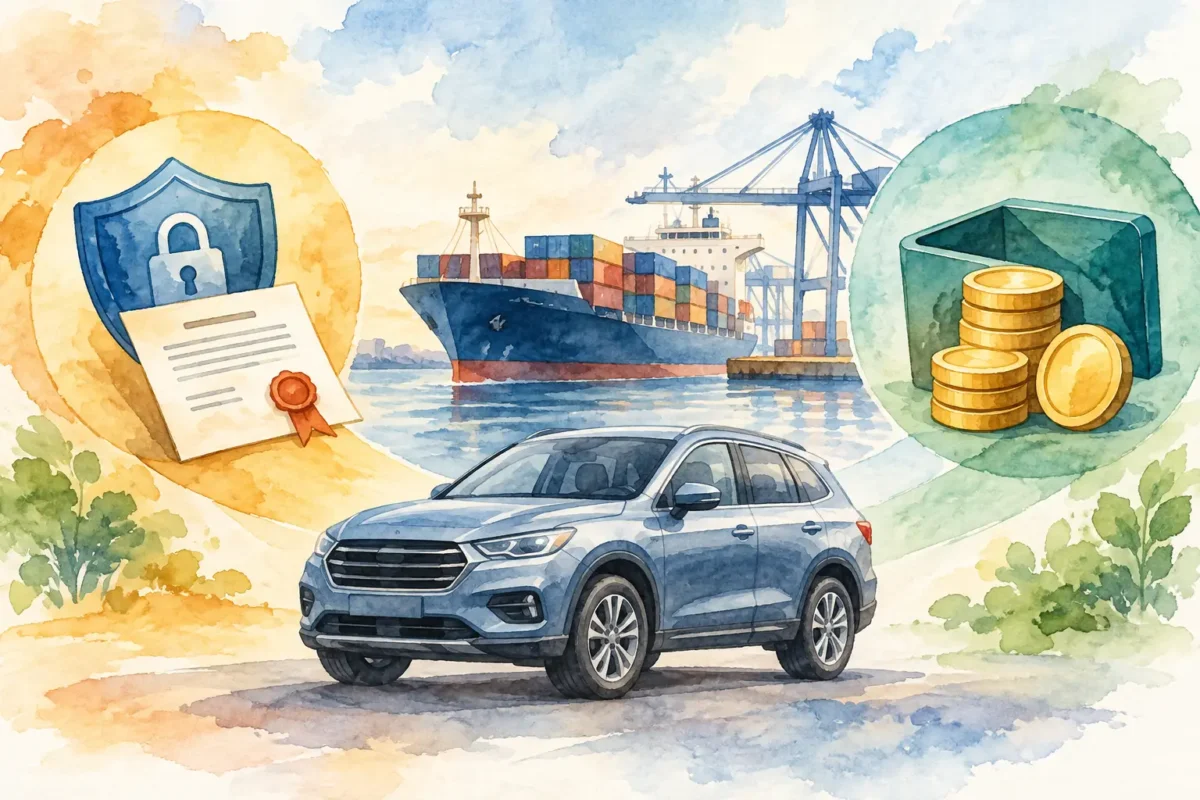
A vehicle can be sitting at the border with a clean title, a paid invoice, and a ready carrier – then customs security becomes the issue holding up release. The customs bond versus deposit question is not just a paperwork detail. It affects how your entry is secured, how much cash is tied up, and what happens if Customs and Border Protection later determines more money is owed.
For U.S.-bound vehicles from Canada or another country, the right answer depends on the vehicle, the entry type, the amount of duty and tax exposure, and the importer’s history. A customs broker can help prepare and transmit the entry, but CBP determines what security it will accept and whether additional security is required.
What a Customs Bond Does
A customs bond is a financial guarantee filed with CBP. It assures the government that the importer will meet obligations connected to an entry, including the payment of applicable duties, taxes, fees, and certain penalties if they become due.
The bond is usually backed by a licensed surety company. Instead of paying the full potential amount to CBP up front, the importer pays a bond premium to obtain the guarantee. This can be especially useful when importing higher-value vehicles, multiple vehicles, commercial trucks, machinery, trailers, or repeat auction purchases.
A bond does not eliminate the importer’s financial responsibility. If CBP makes a claim and the surety pays it, the surety can seek reimbursement from the importer. Put simply, the bond helps secure release and protects the government. It is not insurance that makes a duty bill or compliance problem disappear.
For vehicle imports, bonds are commonly handled as either a single-entry bond or a continuous bond. A single-entry bond is tied to one shipment or entry. A continuous bond generally covers entries over a one-year period and may be a more practical option for dealers, commercial operators, and frequent importers.
When a single-entry bond makes sense
A single-entry bond may be appropriate for a private buyer bringing in one vehicle, such as a collector car purchased in Canada or a vehicle bought through an auction. It can also work when an importer has no recurring U.S. import activity.
The cost is based on the bond amount and the surety’s underwriting requirements. The required bond amount is not always equal to the vehicle’s purchase price. It is set according to CBP rules and the risk associated with the entry. A broker should review the entry details before quoting or arranging security.
When a continuous bond is the better operational choice
A continuous bond is often the more efficient choice for an active dealer or business importing vehicles throughout the year. It reduces the need to arrange separate bond coverage for every qualifying shipment and helps keep repeat entries moving.
That does not mean every importer needs one. If you import one vehicle every few years, a continuous bond may add cost without much benefit. The decision should match your volume, vehicle values, entry frequency, and future import plans.
What a Customs Deposit Means
A customs deposit is actual money provided to secure an obligation. Unlike a bond premium, the deposit itself is the security. CBP may hold the funds while the entry is reviewed, finalized, or otherwise resolved.
In practical terms, a deposit can tie up a significant amount of working capital. That matters when you have just paid for the vehicle, auction fees, transport, storage, compliance work, and border processing. For a dealer moving several vehicles at once, cash deposits can quickly affect purchasing capacity.
A deposit may be requested when CBP wants direct security, when a bond is unavailable or insufficient, or when the entry involves a question that must be resolved after release. The circumstances vary. CBP has discretion over security requirements, so no broker can promise that a bond will always replace a deposit.
A deposit should also not be confused with duties and taxes that are actually owed. Depending on the entry, funds may be collected toward estimated duties, taxes, or fees. If amounts are later adjusted, there may be a refund or an additional balance due. The entry documents must clearly show what was paid, why it was paid, and whether the amount is final or held as security.
Customs Bond Versus Deposit: The Practical Difference
The central difference is straightforward: a bond is a third-party guarantee, while a deposit is cash placed at risk directly by the importer.
A bond usually preserves cash flow because the importer pays a premium rather than depositing the full security amount. A deposit requires immediate funds but may be the available option in a particular circumstance. Neither option changes the need for accurate documentation, admissibility review, or proper duty and tax handling.
For a vehicle importer, the decision often comes down to four practical questions:
- Is this a one-time import or part of an ongoing import program?
- Does the entry have a compliance, valuation, or classification issue that may require extra security?
- How much cash can be tied up without delaying the purchase, transport, or next auction acquisition?
- Has CBP specified the type or amount of security required?
The last question controls. An importer can prefer a bond, but CBP may require additional or different security based on the facts of the entry.
Why Vehicle Entries Need Careful Review
Vehicles are not ordinary consumer goods. Their admissibility can involve title documents, ownership records, manufacturer labels, safety requirements, EPA-related requirements, recall clearance, and the precise condition and configuration of the vehicle.
For example, a vehicle built to Canadian specifications may require a different review than a U.S.-certified vehicle returning to the United States. A heavy-duty truck, bus, RV, salvage vehicle, or modified vehicle can introduce additional questions. If documents do not line up with the VIN, purchase records, vehicle classification, or intended use, the security discussion can become only one part of a larger release issue.
Importers should not assume that a paid auction invoice proves the customs value or that a title alone proves admissibility. CBP may review the declared value, and federal agencies may have separate requirements affecting whether the vehicle can enter the country. A bond can secure an obligation, but it cannot cure missing compliance documents.
Timing Matters at the Border
Security should be addressed before the vehicle reaches the port whenever possible. Waiting until the driver is at the border can create storage charges, carrier delays, missed delivery appointments, and unnecessary pressure to make decisions without complete information.
This is particularly important for title-based exports from the United States to Canada and then re-imports, auction pickups, and commercial equipment moves. The title submission timeline, export filing requirements where applicable, carrier scheduling, and import entry all need to work together.
A hands-on import partner can review the vehicle file early, identify whether bond coverage may be needed, coordinate the customs entry, and keep transport aligned with border timing. Bidbuy Importers handles that coordination for customers moving passenger vehicles, commercial units, RVs, trailers, and machinery across the U.S.-Canada border.
Documents That Support a Clean Entry
A complete file gives your broker and CBP a clearer basis for handling the entry. For most vehicle imports, this generally includes the ownership document or title, bill of sale or purchase invoice, VIN details, importer information, transport details, and any required compliance or recall documentation.
The exact requirements depend on the vehicle and transaction. A dealer importing inventory may need different supporting records than a private buyer bringing home one collector vehicle. Commercial vehicles can require further documentation based on their use, weight, equipment, and regulatory status.
Accuracy matters more than speed alone. A rushed declaration with the wrong VIN, value, vehicle type, or importer name can create delays that cost far more than a proper pre-border review.
Choose Security Based on the Entry, Not Assumptions
A customs bond is often the efficient tool for securing a standard vehicle entry, especially where preserving cash flow matters. A deposit can be necessary when CBP requires direct funds or when the circumstances of the entry call for it. The correct approach is not about choosing the cheaper-looking option on paper. It is about using the security method that supports a compliant release without exposing your transaction to avoidable delay.
Before you arrange pickup or send a carrier to the border, have the vehicle documents reviewed, confirm the entry plan, and ask what security may be required. That preparation gives you a far better chance of moving the vehicle on schedule and keeping your money, paperwork, and transport plan under control.