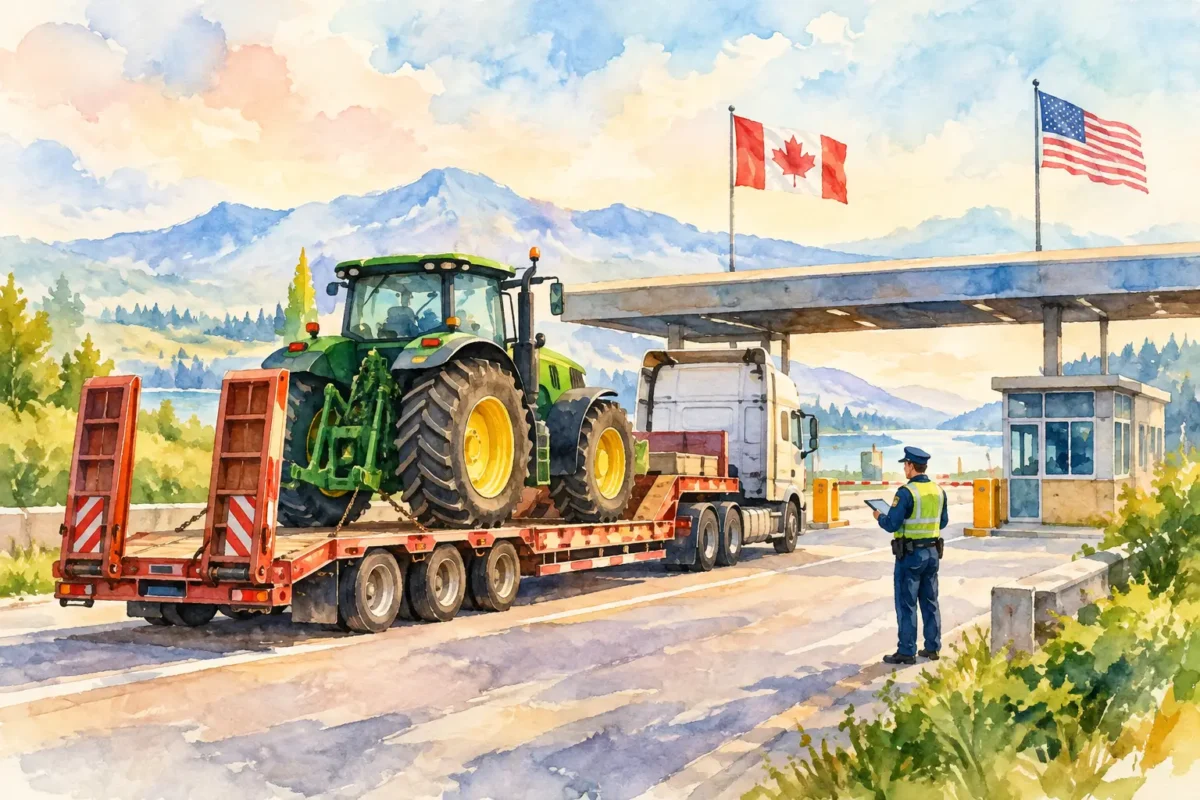
A combine bought at auction can look like a great deal until it reaches the border with no clear ownership record, the wrong customs classification, or a transport plan that does not account for its width and weight. To import farm machinery between the United States and Canada, the machine itself is only part of the transaction. The paperwork, admissibility review, customs entry, and delivery plan need to be handled before it is loaded.
Farm equipment crosses the border every day, from compact tractors and skid steers to harvesters, sprayers, balers, excavators, trailers, and semi tractors used in agricultural operations. The process can be straightforward when the equipment, documents, and route are reviewed early. It becomes expensive when decisions are left until the truck is at the port.
Start With the Exact Machine You Are Importing
“Farm machinery” is a broad description, but customs and transport requirements depend on the specific unit. A self-propelled tractor is treated differently from a pull-behind implement. A road-legal truck used on a farm is not the same as an off-road loader. Equipment with an installed diesel or gasoline engine may have emissions requirements that do not apply to an unpowered cultivator or hay rake.
Before arranging pickup, gather the year, make, model, serial number, engine information, purchase price, country of manufacture, current location, and intended use. Clear photos of the identification plate, serial number, and machine condition are also useful. This information helps determine the proper tariff classification, potential duty treatment, and whether any compliance issues need attention.
Country of manufacture matters. Equipment made in the United States, Canada, or Mexico may qualify for preferential treatment under the United States-Mexico-Canada Agreement if the origin rules and supporting documentation are satisfied. That does not mean every agricultural machine crosses duty-free automatically. The classification, origin, and transaction details must support the claim.
Documents Needed to Import Farm Machinery
The basic document package should be ready before the equipment leaves the seller. At a minimum, buyers generally need a detailed bill of sale or commercial invoice showing the buyer and seller, purchase price, currency, machine description, serial number, and terms of sale. Customs also needs enough detail to identify what is being imported and establish its value.
Ownership documents require special attention for self-propelled equipment. Depending on the machine and the direction of travel, this may include a title, registration, transferable ownership document, manufacturer’s statement of origin, or auction paperwork. A bill of sale alone may not resolve ownership questions for every unit.
If equipment is being exported from the United States into Canada, used self-propelled vehicles can be subject to U.S. export requirements, including advance title submission to U.S. Customs and Border Protection. The familiar 72-hour rule can apply in situations involving qualifying used self-propelled vehicles, but buyers should not assume it applies or does not apply based only on the word “tractor.” The equipment type, documentation, and port procedures should be confirmed before pickup.
For commercial movements, an accurate commercial invoice, packing details where applicable, and export filing information may also be required. Electronic Export Information through the Automated Export System can be necessary depending on the shipment and its value. Missing export documentation can hold up a shipment even when the buyer has already paid for transport.
Customs Classification, Duty, and Tax Are Not Afterthoughts
A customs entry begins with correct classification. Agricultural machinery can fall under different tariff provisions based on what it does, whether it is self-propelled, and how it is equipped. A machine described too generally as “farm equipment” can create avoidable questions, corrections, delays, or incorrect duty assessment.
The purchase price is not always the only figure customs considers. Transportation, assists, commissions, and other transaction details can affect customs value depending on the circumstances. Used equipment should be priced realistically and supported by auction records, invoices, payment confirmation, or appraisals when needed. Declaring a low value to reduce duty or tax exposure can create serious compliance problems.
Importers should also budget for taxes and fees separately from the auction hammer price. A Canadian import may involve Goods and Services Tax and, depending on the destination and transaction, provincial tax considerations. A U.S. import may involve duty, merchandise processing fees, and other applicable charges. The final cost depends on the machine, origin, entry type, and destination.
A customs broker can prepare and transmit the entry, but the importer remains responsible for the accuracy of the information supplied. The best approach is to obtain a cost and documentation review before funds are released to the seller, not after the equipment is already in transit.
Engine and Safety Rules Can Apply to Farm Equipment
Many farm machines are off-road and are not imported under the same framework as passenger vehicles. That does not make compliance automatic. Equipment with an engine may be subject to U.S. Environmental Protection Agency requirements, particularly when it contains a nonroad compression-ignition or spark-ignition engine. The engine label, model year, and configuration matter.
A machine that has been modified, repowered, or assembled from components deserves a closer review. So does a unit that is marketed as agricultural equipment but is capable of highway operation. Road-going tractors, trucks, trailers, and equipment that requires registration can bring additional Department of Transportation, National Highway Traffic Safety Administration, state, or provincial requirements into the process.
For imports into Canada, the Registrar of Imported Vehicles program may apply to certain regulated road vehicles, while many purpose-built off-road farm machines fall outside that program. The distinction is not something to guess at from an online listing. Confirm whether the unit is designed for public-road use and what documentation is available before committing to the purchase.
Clean Equipment Prevents Border Delays
Soil, plant debris, seeds, manure, and standing water are common reasons agricultural equipment receives extra attention at the border. A machine that has spent years in a field can carry material in the undercarriage, tires, tracks, steps, headers, toolbars, and hydraulic areas. Canadian agricultural inspections can be particularly strict when equipment arrives visibly contaminated.
Have used machinery professionally cleaned before it is presented for export or import. The goal is not a cosmetic wash. It is removal of soil and organic material from every area inspectors can reasonably access. Keep cleaning records and recent photos when possible. If an inspection leads to an ordered cleaning or treatment at the border, the shipment can lose days and incur costs that were easy to avoid.
Wood packaging is another detail that can matter. Crates, blocking, and pallets used in international shipments may need to meet applicable wood packaging requirements. A transport provider should know what is being used to secure the machine and whether it is acceptable for the crossing.
Build the Transport Plan Around the Equipment
Transporting a compact tractor may be a standard flatbed move. Transporting a combine, articulated tractor, high-clearance sprayer, or oversized implement is a different operation. Width, height, length, axle weights, removable components, loading access, and seasonal road restrictions all affect the route and price.
Oversize equipment may require permits, pilot cars, escorts, disassembly, or a specialized lowboy or step-deck trailer. The lowest freight quote is not always the right choice if the carrier has not verified dimensions or border capability. Equipment can arrive at a port unable to proceed because the load was measured incorrectly or the carrier lacks the proper documents.
Timing matters as well. Border hours, advance export submissions, inspection availability, carrier dispatch schedules, and the seller’s loading equipment should all be coordinated. If the machine is purchased from an auction yard, confirm how long it can remain on site and whether the yard will load it. Storage charges can begin quickly after the sale closes.
Use One Plan From Purchase to Delivery
The most reliable import farm machinery process connects the purchase, export review, customs entry, border crossing, and final delivery. Splitting those tasks among multiple parties can work, but it creates gaps when no one owns the full timeline. A title may be sent to the wrong port, a carrier may arrive before clearance is ready, or customs may need a detail that the auction seller cannot provide quickly.
Bidbuy Importers coordinates cross-border customs handling, export documentation, compliance support, storage, and specialized transportation for commercial equipment and machinery. A pre-purchase review can identify the documents and timing requirements before a buyer is committed to an avoidable problem.
Before you place the final bid or release payment, have the serial number, ownership papers, engine details, dimensions, and pickup location reviewed as one file. That small step gives you a clearer landed cost and a much better chance of seeing the machine arrive ready for work, not waiting at the border.