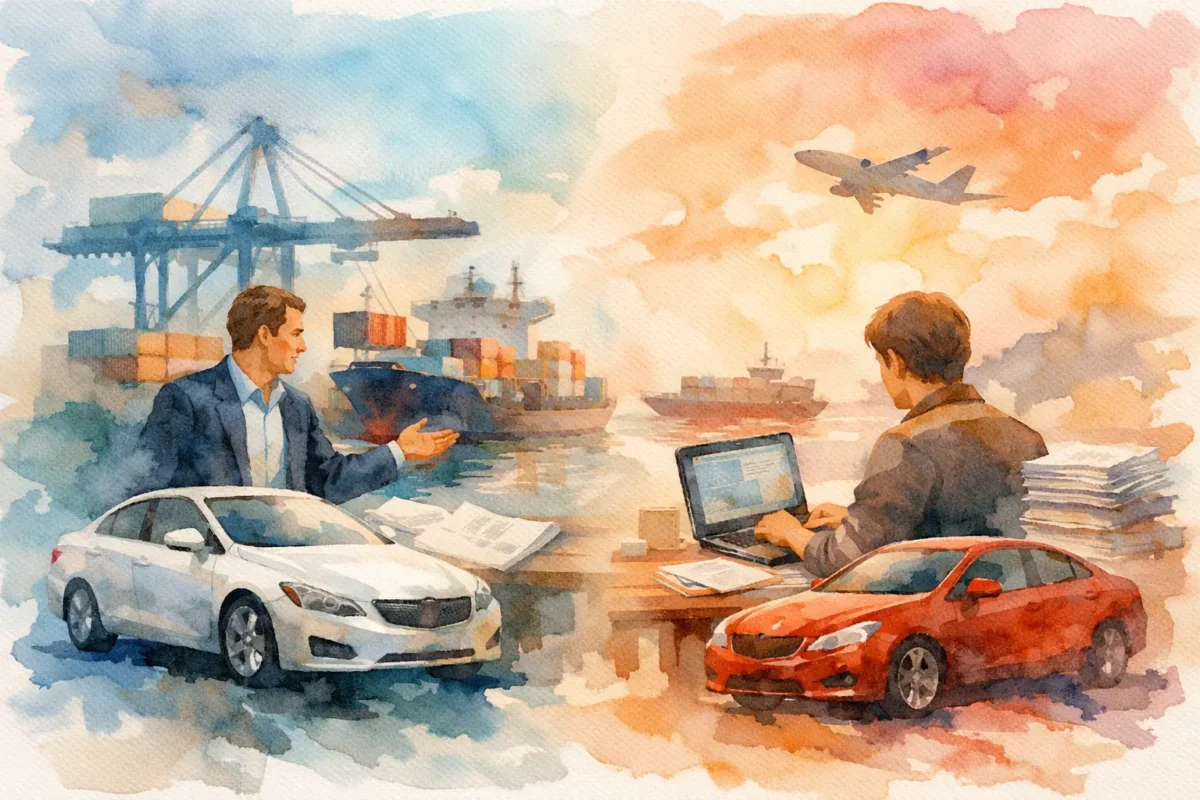
A vehicle can look like a great deal right up until the paperwork starts. That is usually when people begin comparing car import broker vs self filing and asking the real question: am I saving money by doing this myself, or am I taking on expensive risk I do not fully see yet?
For some importers, self-filing works. For others, it turns a straightforward purchase into delays at the border, missed title deadlines, rejected filings, storage fees, and compliance problems that cost more than professional help ever would. The right choice depends on the vehicle, the border crossing, the documentation, and how comfortable you are handling customs and regulatory requirements without backup.
Car import broker vs self filing: what changes in practice
On paper, the difference seems simple. With self-filing, you prepare and submit the required documentation yourself, coordinate with the port, meet export notice rules, and manage the customs entry process. With a broker, you hire a licensed professional to handle those steps and help keep the transaction compliant.
In practice, the gap is much bigger than paperwork alone. Vehicle imports between the US and Canada often involve title verification, VIN matching, export notice timing, customs release, recall clearance, admissibility checks, tax calculations, and transportation coordination. If the unit is not a standard passenger car, the complexity rises fast. Trucks, trailers, RVs, buses, semi tractors, and machinery often come with a different level of scrutiny and a longer checklist.
That is why this decision is less about whether you can fill out forms and more about whether you can manage the full chain without a mistake.
When self filing makes sense
Self-filing is not automatically a bad idea. If you are importing a straightforward, clearly admissible vehicle, have prior border experience, understand the timing rules, and have the time to stay involved, doing it yourself may be reasonable.
The best self-file candidates are usually buyers handling a simple transaction with clean paperwork. The title is in order, the seller is responsive, the VIN and ownership details match exactly, and the vehicle does not raise unusual EPA, DOT, NHTSA, or provincial registration issues. In those cases, the process can be manageable if you are organized and willing to deal directly with customs offices and supporting agencies.
Cost is the main reason people choose this route. They want to avoid brokerage fees and keep total acquisition costs down. That can work, but only if the process goes smoothly. The savings disappear quickly when a filing error causes a delay, a trip needs to be rescheduled, or the vehicle cannot clear when expected.
Self-filing also makes more sense for experienced importers. Dealers and repeat buyers who already know port procedures, document flow, and compliance checkpoints may have systems in place. They are not learning from scratch, and that matters.
When a broker is the better decision
A broker becomes the better choice when the transaction has any real complexity, when timing matters, or when the buyer simply does not want to gamble on border compliance.
That includes first-time importers, auction buyers, private buyers purchasing remotely, and commercial operators moving higher-value equipment. It also includes situations where documents are still being gathered, title history is unclear, the exporting party is unfamiliar with border rules, or transportation needs to be coordinated around release timing.
A professional broker does more than submit forms. The real value is knowing where imports go wrong before they go wrong. That includes checking whether the title is acceptable for export, confirming notice periods, flagging missing supporting documents, identifying compliance concerns early, and matching the process to the correct port procedures.
For many customers, the broker fee is not just paying for convenience. It is paying to reduce the chance of a failed border event.
The real trade-off: lower upfront cost vs lower exposure
The car import broker vs self filing debate usually gets framed as cost versus savings. That is incomplete. The better comparison is lower upfront cost versus lower exposure.
Self-filing can cost less at the start. But you are absorbing the risk yourself. If customs rejects a document set, if export notice was not submitted correctly, if the title has an issue, or if a required compliance item is missing, you own the delay and the consequences. Depending on the circumstances, that may mean storage, extra transportation charges, missed pickup appointments, or lost time trying to get corrections processed.
A broker adds a service fee, but it often reduces total exposure. That matters most when the vehicle is expensive, when delivery timing matters, or when the move involves multiple parties such as auction houses, sellers, transport carriers, border offices, and receiving customers.
This is where many buyers change their thinking. They stop asking, “Can I file this myself?” and start asking, “What happens if something is off by one document, one signature, or one deadline?”
Paperwork is where most self-file problems begin
Most border problems do not start with dramatic compliance failures. They start with ordinary paperwork issues.
A name does not match exactly. A title is signed incorrectly. A bill of sale is incomplete. The VIN on one document differs by a character. A notice deadline is missed. A seller sends a scan that is not acceptable to the port. A buyer assumes customs will explain every next step in detail, only to find that agencies process what is presented and do not manage the transaction for you.
That is why vehicle import paperwork needs to be treated as operational, not casual. Border officers and customs systems are not grading on effort. They are checking whether the entry is supportable and compliant.
For US-Canada vehicle moves, buyers also underestimate how often paperwork and transport timing intersect. A truck can be booked, a driver can be dispatched, and the shipment can still stall because one required document was not in final order. By then, the transport schedule is affected too.
Compliance gets harder as the vehicle gets less ordinary
If you are moving a common passenger vehicle with a clear paper trail, self-filing may still be realistic. Once you get into salvage units, modified vehicles, heavy trucks, RVs, trailers, buses, or machinery, the margin for error shrinks.
Different classes of equipment can trigger different documentation needs, import standards, and release questions. Even when a vehicle is eligible, the supporting process may not be simple. Buyers often assume the difficult part is paying for the unit and arranging transport. In reality, the difficult part is proving the shipment is ready to cross legally and cleanly.
That is where a specialized border company has an advantage. Firms like Bidbuy Importers are built around both compliance handling and physical movement, which matters because customs clearance and transportation are rarely separate in the real world. They affect each other at every stage.
Timing matters more than most people expect
One of the biggest reasons buyers hire a broker is speed with fewer surprises. Not speed in the sense of skipping rules, but speed in the sense of getting the process right the first time.
Border moves are deadline-sensitive. Export notice requirements, title submission windows, customs office hours, carrier pickup schedules, and receiving arrangements all have to line up. If one part slips, the rest of the plan often slips with it.
Self-filing can work if you have time to monitor every step and correct issues as they arise. But many buyers do not. They have jobs, travel constraints, auction deadlines, dealer inventory turnover needs, or customer delivery commitments. In those cases, the question is not just whether self-filing is possible. It is whether it is the best use of your time and risk tolerance.
How to decide between a car import broker and self filing
Start with the vehicle itself. Is it standard, clearly admissible, and supported by complete documents? Then look at your experience. Have you handled US-Canada vehicle filings before, or would this be your first attempt? Then consider timing. Can you absorb delays without creating additional costs?
If the vehicle is simple, your paperwork is clean, and you already understand the border process, self-filing may be a reasonable option. If any part of the move feels uncertain, the safer path is usually professional handling.
That is especially true if the purchase price is significant. The higher the value of the unit, the less sense it makes to expose the transaction to avoid a service fee that may be small compared with the cost of a problem.
A good rule is this: if you would not feel comfortable explaining every required step to someone else from memory, you probably should not be the one responsible for getting that vehicle across the border alone.
The best imports are usually the ones that feel uneventful. Documents are correct, deadlines are met, the vehicle clears properly, and transport happens when expected. Whether you get there through self-filing or with a broker, that is the result that matters.